Opening skill path
Checking your latest progress.
Checking your latest progress.
Intro to Multi-Agent Systems
Daily path
Day 1 · From One to Multiple Agents
8 minOne agent can do a lot. Multi-agent systems help when the work benefits from being split across focused contexts.
You have already seen how an agent can use tools, follow workflows, remember useful context, and work inside a scoped environment.
That gives one agent a lot of reach. But as the task grows, everything starts competing for the same attention: more files, more searches, more decisions, more unfinished work.
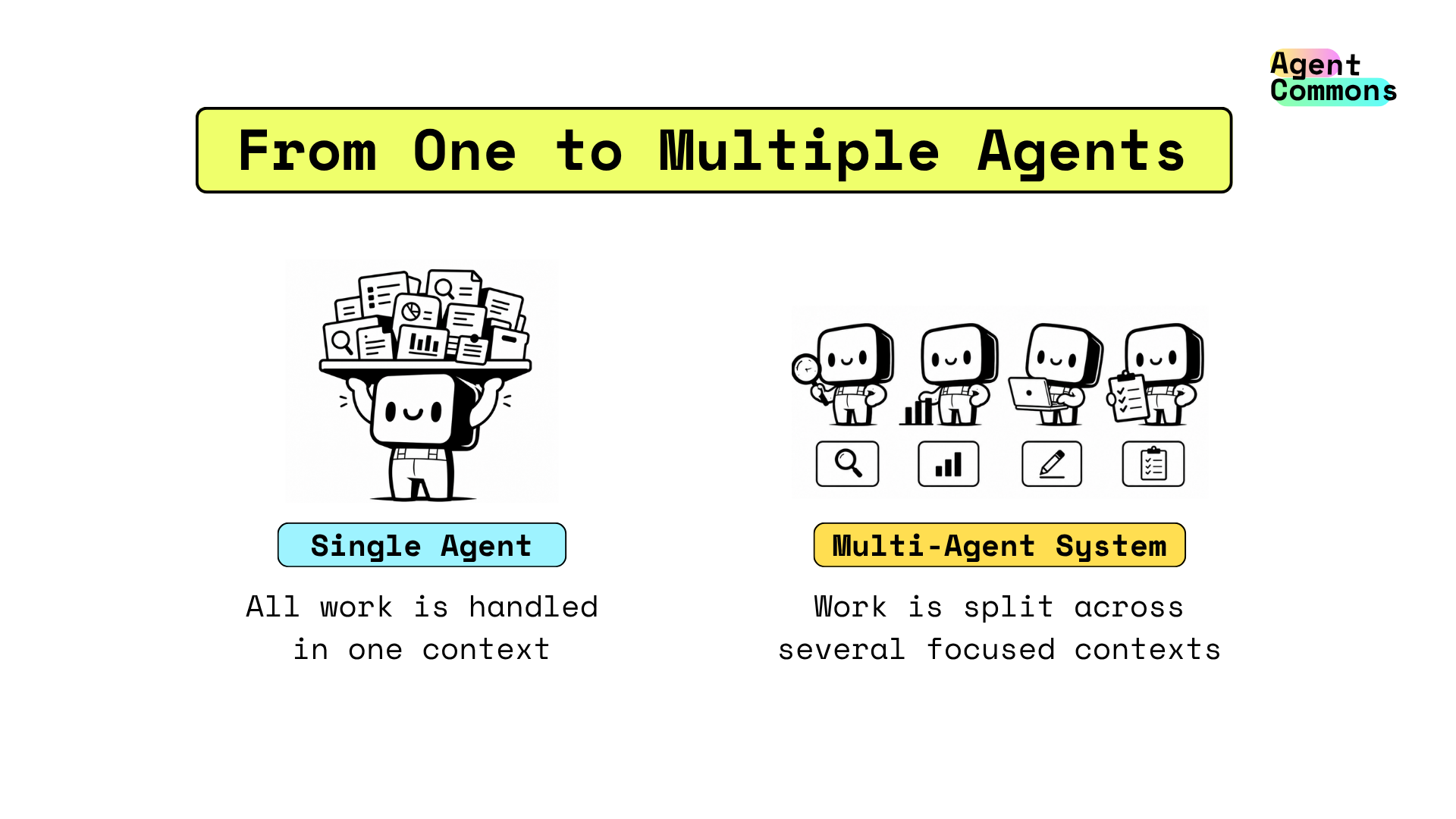
A single agent is not automatically incapable in that situation. It may simply be carrying too much at once inside one context.
That is where multi-agent systems come in. They split work across several focused contexts. One agent might research. Another might analyse. Another might write. Another might review.
The point is not adding agents for decoration. It is keeping work separated while preserving one shared goal. Only the useful result needs to move forward.
So when does it actually make sense to use multiple agents? When the work benefits from being split across focused contexts.
That usually happens in three cases. Parallelism: different parts of the work can happen at the same time. Specialization: different agents can use different roles, tools, prompts, or models. Verification: one agent can check another agent's output.
But more agents also means more coordination. More moving parts can increase cost, latency, and debugging difficulty.
So multiple agents make the most sense when the work is large, parallel, or specialized enough to benefit from being split across focused contexts.
Key ideas